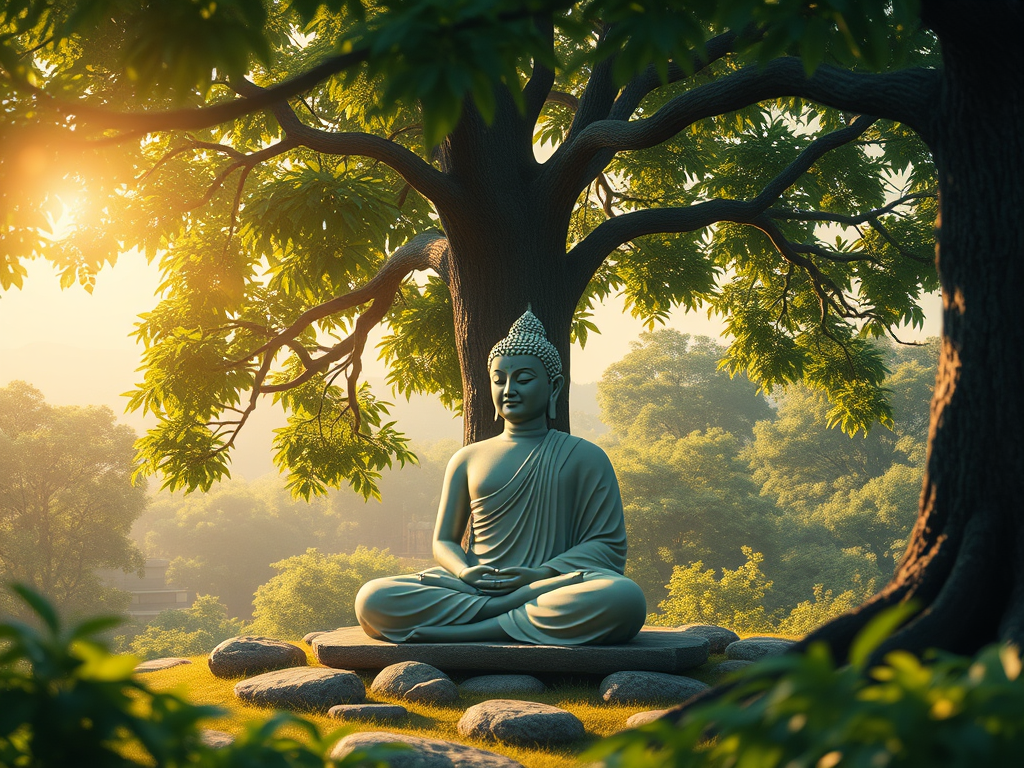

Siddhartha Gautama was born in the 6th century B.C.E., the Axial Age of Confucius in China, Cyrus the Great in Persia and Pythagoras in Greece.[1] He was the son of a wealthy and powerful ruler of Lumbini, present-day Napal, India. As a Prince, Siddhartha was raised in an isolated existence of extreme luxury, protected from the harsh reality of everyday life. It is told that Siddhartha first encountered illness and death in his 29th year. Already married and a father, he ventured outside the palace gates. During his journey, experiencing these realities of life he encountered a man smiling with peace and contentment. Saddhartha asked his chariot-driver how anyone could be happy amidst suffering and death and he was told that the man was a holy man who had achieved liberation. This experience radically informed Siddhartha’s outlook. He vowed to become a holy man and walked away from the palace and his family in search of liberation and a solution to the problem of human suffering.[2]
His journey from extreme self-indulgence through extreme asceticism discovered an awakened state and the Middle Way. “In one of the great moments in world history, he saw that all things are impermanent and ever changing. He saw how we suffer because we wish the world were otherwise. And through these insights he saw his suffering itself wander away. From that point forward he was the Buddha, which, like the term Christ, is a title rather than a proper name. In this case the title means not messiah but “Awakened One”.[3]
Through teaching the Middle-Way the Buddha revealed to his followers the Four Nobel Truths and the Eight-Fold Path. The Four Nobel Truths are:[4]
- Life is suffering.
- Suffering has a cause, craving and attachment.
- Craving and attachment can be overcome
- The path toward the cessation of craving and attachment is the Eightfold Path:
- Right understanding of the Four Nobel Truths
- Right intention – goodwill, compassion
- Right Speech – Truth, Harmony, Understanding
- Right Action – Obey the five precepts for living
- Right Livelihood – Do not harm
- Right Effort – Develop wholesomeness in mind and behavior
- Right Alertness – Practicing Awareness, non judgement, presence
- Right Concentration – Meditation
“Today, roughly 445 million people are Buddhist” and of all the Asian religions, Buddhism has had the largest influence on European and American popular culture.[5] There are two main branches of Buddhism, Mahayana and Theravada. The Theravada, “the way of the elders”, emphasizes a solitary life of personal religious tradition.[6] The Mahayana, “the great vehicle,” puts less importance on a life of seclusion and more importance on the compassion and service of others. Importantly, within the Mahayana there are several unique schools of Buddhism. Some of the most well-known are Pure Land, Tibetan, and Zen. While Theravada Buddhism remains influential in Southeast Asia and is considered closer to early Buddhist teachings, Mahayana Buddhism’s adaptability and diverse schools have contributed to its greater global influence in the contemporary world. It is the Mahayana branch of Buddhism that is most suited to promote the harmony and wisdom needed to address the problem of global warming. As a whole, “Buddhists have traditionally focused on the individual more than society.”[7] The Four Nobel Truths and Eight-Fold Way has traditionally focused on the conduct of the individual and his or her view of the world. However, “over the last generation Buddhist have responded to such criticisms with “Engaged Buddhism,” a term coined by the late Vietnamese Zen Buddhist monk Thich Nhat Hanh” (1926 – 2022).[8] Today, Engaged Buddhists are working to address the social roots of suffering through collective action. A significant and growing cause of social suffering is global warming .
In 1998 the Intergovernmental Panel on Climate Change (IPCC) was created to assess and synthesize scientific knowledge on climate change. Its formation and development have been crucial in shaping global understanding and policy responses to climate-related issues. The IPCC has completed six assessment cycles since its inception, producing comprehensive Assessment Reports (AR). The fourth assessment report (AR4) in 2007 laid the groundwork of limiting future global warming to 2 degrees Celsius. The fifth assessment (AR5) in 2013-2014 laid the groundwork for the Paris Climate Agreement.[9] It was In 2014, that United Nations Framework Convention on Climate Change (UNFCCC) approached Thich Nhat Hanh as an international faith leader, to request a brief statement about climate change and our relationship to one another and to the Earth.
Thich Nhat Hanh’s message emphasized our interconnectedness with the Earth. The core of his teaching revolves around the concept of “interbeing” – the deep interconnection between humans and the Earth. He encourages us to cultivate mindfulness and develop a loving relationship with our planet, seeing it not just as our environment, but as an extension of ourselves. Along with practical advice on reducing consumption, especially meat and alcohol, he also highlights the importance of community and cooperation to address environmental challenges. Ultimately, Thich Nhat Hanh’s message is one of love and awakening. He believes that by falling in love with the Earth, we can find the motivation and strength to change our way of life and protect our planet.
On March 20, 2023, the Intergovernmental Panel on Climate Change’s (IPCC) Sixth Assessment Report (AR6) was released. This report outlines the findings of an eight-year study, combining the work of over 700 scientists on the physical science of climate change, impacts and vulnerability to climate change and climate change mitigation. The report provides a grim review of the consequences of rising greenhouse gas (GHG) emissions around the world. The window to address this crisis is rapidly closing but, as the IPCC affirms, as of the date of the report, there is still opportunity to secure a safe and livable future on this planet. Some key findings of the report are:
- The human-induced global warming of 1.1 degree Celsius has created the warmest decade on record, sea levels are rising faster than any century in for 3000 years, ocean warming is occurring faster than any time since the last ice age, ocean acidification is at the highest level of the last 26000 years. The continued increase in warming translates to the frequency and severity of heat extremes, heavy rainfall events and regional droughts. The continued rise in global temperature will trigger self-amplifying irreversible feedback loops caused by thawing of perma-frost and massive forest die off.
- With every fraction of a degree of warming, human suffering increases due to enabling the spread of vector-borne diseases such as malaria, West Nile virus and Lyme disease. The change in temperature will continue to slow agricultural productivity in regions already suffering from drought and famine. Since 2008, the extreme floods caused by warming have forced an estimated 20 million from their homes – every year.
- The necessary adaptations to limit global warming, while still possible, will require deep GHG emission reductions in the near term. Since this report, we continue to experience an increase in the global average temperature.
- To successfully adapt the world must rapidly shift away from burning fossil fuels – the number one cause of the climate crisis
- While burning fossil fuels are the number one source of GHG emissions, deep emission cuts are necessary across all of society to combat the climate crisis, this includes, agriculture, transportation, deforestation, land management, and even technology data centers.
- Globally, the households with incomes in the top 10% emit close to 45% of the worlds GHG’s, while those in the bottom 50% account for less than 15%.
We have clear evidence that without a dramatic and rapid change in the how we support and nurture the planet, the planet will no longer support and nurture human life
It is the concept of interconnectedness and Thich Nhat Hanh’s teaching on “inter-being” (discussed in his message to the United Nations) that continues to draw me towards Buddhism’s potential to wake up us to the reality that our approach to life, especially in Western Culture must change, for us to survive. Buddhists of all stripes share the conviction that “they trace suffering to “ignorant craving”—our tendency to mistake things that are changing as unchanging and then to cling desperately to their supposedly unchanging forms.”[10] In his famous words, Nhat Hanh makes the case for Engaged Buddhism by describing how, even when we meditate privately, we are interacting with all of creation: “When we go to a meditation center, we may have the impression that we leave everything behind—family, society, and all the complications involved in them—and come as an individual in order to practice and to search for peace. This is already an illusion, because in Buddhism there is no such thing as an individual. Just as a piece of paper is the fruit, it is the combination of many elements that can be call non-paper elements, the individual is made of non-individual elements. Without a cloud there will be no water; without water, the trees cannot grow; and without trees, you cannot make paper. So, the cloud is in here…In the same way, the individual is made of non-individual elements. How do you expect to leave everything behind? When you meditate, it is not just for yourself, you do it for the whole society.”
Engaged Buddhism isn’t some new idea being introduced in the 21stcentury to address 21st century problems. It is supported by the earliest teachings of the Buddha. “Ariyarantne writes: One of the unique teachings of the Buddha is the theory of dependent arising. Everything is related to every other thing. If there is no peace in a society, there should be a variety of interdependent and interrelated causes that bring about such a situation.”[11] Identifying the causes and reducing or eliminating them through cooperation is where Engaged Buddhism shines. “One of the key points that Engaged Buddhists return to again and again in their thinking is the fact that human beings are social beings –that is, each one of lives in a condition of interdependence within society.”[12]
Still, how can Buddhism draw the top 10% who emit 45% of the global GHG’s, “out of their palace” to find the Buddha , to find Christ, to realize the truth of our interconnected reality? As I write these words, America and global politics, are leaning towards further isolation and individualism. The political leaders and the wealthy and powerful don’t want to leave the walls of the palace! Sadly, the United States, the biggest Western producer of GHG’s is now leading the way towards this “palace life”, this disconnected life driven by greed and the “ignorant craving” of illusory comfort, wealth and power. The capitalist machine has reached its own amplifying feedback loop. Social Media dominates the attention span of humanity for the primary purpose of marketing a life of illusion to the masses. The powerful remain in power by protecting this “machine” at all costs. This continued “ignorant craving” could literally bring about the death of the planet that is not only our home but is part and parcel of our being. We continue to fiddle while the planet, our home, burns.
I have found some encouragement in the story of Liu Jianqiang,[13] who is one of millions of Chinese who are returning to Buddhist, Daoist, and Confucian temples that have at times in the past been condemned by the government. But today these temples are alive with worshippers. According to some surveys, nearly 1 in 5 Chinese—that’s more than 240 million—are Buddhists. Some scholars say this search for faith is linked to China’s massive environmental problems.
Perhaps, the ecological crisis that is the cause of global warming is awakening the youth of western culture, and perhaps like Siddhartha Gautama, they will venture outside of the palace into our interconnected global reality. So, while it is clear that people in the west are leaving traditional institutional religions (Catholic and Protestant) and becoming either atheist, spiritual not religious, or simply seeking, this large group, like the Liu Jianxiongs’ of China, could bring about the change needed in religion to offer meaning and fulfillment in a new and vibrant way.
With Christianity being the dominate religion in the western world, and therefore the religion of the leading producers of GHG’s, Pope Francis’ publication of Laudato Si (On care of our Common Home) on May 24, 2015 also provides reason for hope. In this encyclical “The pope highlights relationality as the foundation of all life, impelling him to posit a new metaphysics of relationship grounded in divine love. We are not simply human beings; we are human interbeings and share in the interrelatedness of all cosmic life.”[14] “Laudato Si’ supports evolution, the Pope writes that God is “creating a world in need of development.” The pope states that “God in some way sought to limit himself” in this creating process, thus allowing new things to emerge. He sees God’s love as “the fundamental force in all created things” and the power of love “intimately present to each being, without impinging on the autonomy of the creature,” allowing the creaturely life to unfold in freedom. “Laudato Si’ opens the doors to a new world by challenging a selfish world of disconnectedness and calling all people to a new world of interrelatedness.”[15]
Christian religious scholar Julius-Kei Kato suggests that a Christion-Buddhist hybridity of the two spiritual-religious traditions to draw people in either tradition to support an interconnected theological and spiritual approach to ecology. This hybridity, according to Kato, is necessary for a meaningful paradigm shift to occur in the West. Kato states “despite the significant gains in the Catholic Christian reflection on ecology achieved through Laudato Si, it cannot be denied that Christian theology in general, as well as how it treats ecological themes in particular, is still fundamentally characterized by an anthropocentric focus that dualistically distinguishes too strongly between humans, on the one hand, and nature, on the other. Thus, Christian theological reflection on ecology might be helped and complemented by utilizing a nondual and unity paradigm. One such paradigm is the Buddhist teaching on interbeing as expressed, for example, by teachers such as Thich Naht Hanh.”[16] Kato’s Christian-Buddhist hybridity provides a compelling case that the claim of superiority of one tradition or culture is a fossilized version of theology and spiritualty that prohibits the embrace of “interbeing” globally. This view is echoed byilia Delio words: “As long as we insist on old, quasi-dualistic ideas on what is “physical” and “spiritual” (for example, “body and “soul”) and do not see that we are fundamentally energy-turned-matter, we will continue to live on a lower level of evolution, as competitive individuals, spiraling downward toward global destruction.”[17] Karl Rahner also concludes that “on the one hand the experience of God and the experience of self are one, and on the other that the experience of self and the encounter with neighbor are one, that all these three experiences ultimately constitute a single reality with three aspects mutually conditioning one another .”[18] As Russell states “the result is a surrender of self to that reality that manifests itself in an interdependence with a radical love for all of humanity.”
This hybridity paradigm accepts that the truth is “closer to the notion that there is no culture or even religious tradition superior to others but that different cultural worlds and faith traditions are just diverse, yet valid ways of being human and spiritual.”[19] Hybridity may allow for the renewal needed to welcome the youthful seekers of the West into a hybrid version of Engaged Buddhism. “Many of our young people are uprooted. They no longer believe in the traditions of their parents and grandparents and they have not found anything else to replace them. Buddhism, like Christianity, and other traditions has to renew itself in order to respond to the needs of the people of our time.”[20] Embracing Christian-Buddhist hybridity could provide the language that speaks to the youth and the path to the eternal truths taught by Christ and Buddha.
What actions are happening now and what actions can be taken to welcome this approach across the Buddhist and Christian faiths? The following organizations are currently leading the way to foster interfaith dialog across all faiths globally. By working together through organizations like these, the concept of hybridity becomes something real and alive in community. It is time to encourage participation and investment in these and other organizations to bring the wisdom of “inter-being” into action. This can be amplified by making the case to the local parishes, temples and synagogues. By combining our approaches in interfaith initiatives, while respecting the diverse views of each faith and culture, avoiding the stance of superiority, we may gain the critical mass needed to save the planet and reduce suffering.
One Earth Sangha: https://oneearthsangha.org/about-us/?t Interfaith Power and Light: https://interfaithpowerandlight.org Green Faith: https://greenfaith.org/
How can we as a society find the “middle-way” between extreme self-indulgence and self-induced destruction? Perhaps the answer lies with the seekers, the atheists, the spiritually but non-religious as the catalyst for change. Like Liu Jianqiang in China and the millions like him, the loving Creator is drawing them out of “self” containers, palaces that no longer have meaning, toward a life of meaning, inter-being and eternal love. I do believe we are at the beginning stages of a global paradigm shift but the direction remains unclear. All ways involve suffering, as does all of life. But, one way, leads enlightenment and eternal love. We must act now and lead the way toward love. I believe the teachings of the Buddha, engaged Buddhism and “Loving our Neighbor as ourselves, as Christ commands, will guide the way.
Bibliography
Boehm, Sophie, and Clea Schumer. 2023. “10 Big Findings from the 2023 IPCC Report on Climate Change.” World Resources Institute. 2023. https://www.wri.org/insights/2023-ipcc-ar6-synthesis-report-climate-change-findings?t.
Delio, Ilia. 2021. The Hours of the Universe: Reflections on God, Science, and the Human Journey. Maryknoll, Ny: Orbis Books.
Eastman, Roger. 1999. The Ways of Religion: An Introduction to the Major Traditions. 3rd Ed. New York: Oxford University Press.
Hanh, Nhât. 2015. Living Buddha, Living Christ. New York: Riverhead Books.
Kato, Julius-Kei. 2022. “What Has Hybridity Got to Do with Ecology? What Christian-Buddhist Hybridity-As-Hermeneutical-Lens Can Suggest to the Theological Conversation on Ecology.” Buddhist-Christian Studies 42 (1): 105–17. https://doi.org/10.1353/bcs.2022.0005.
King, Sallie B. 2005. Being Benevolence: The Social Ethics of Engaged Buddhism. Honolulu: University of Hawaii Press.
Prothero, Stephen R. 2011. God Is Not One: The Eight Rival Religions That Run the World, and Why Their Differences Matter. Collingwood, Vic.: Black Inc.
Russell, Heidi Ann. 2008. “Keiji Nishitani and Karl Rahner: A Response to Nihility.” Buddhist-Christian Studies28 (1): 27–41. https://doi.org/10.1353/bcs.0.0010.
Toropov, Brandon, and Luke Buckles. 2011. The Complete Idiot’s Guide to World Religions. 4th Ed. New York, N.Y.: Alpha.
[1] Prothero, Stephen R. 2011. God Is Not One: The Eight Rival Religions That Run the World, and Why Their Differences Matter. Collingwood, Vic.: Black Inc.,170
[2] Toropov, Brandon, and Father Luke Buckles. 2011. The Complete Idiot’s Guide to World Religions, 4th Edition. Penguin.
[3] Prothero, 177
[4] Toropov, 184 with additional information source from class outline in Buddhism.
[5] Ibid., 175
[6] Totopov, 190
[7] Prothero, 180
[8] Ibid., 180
[9] “History — IPCC.” 2019. Ipcc.ch. IPCC. 2019. https://www.ipcc.ch/about/history/?t., accessed 12/2/24
[10] Prothero ,179
[11] King, Sallie B. 2005. Being Benevolence: The Social Ethics of Engaged Buddhism. Honolulu: University Of Hawaii Press.,11
[12] King, 13
[13] From the class video: China, Buddhism and the environment, https://www.pbs.org/wnet/religionandethics/2014/10/24/october-24-2014-china-buddhism-environment/24431/, accessed 12/2/24
[14] Delio, Ilia. 2021. The Hours of the Universe. Orbis Books.,59
[15] Delio, 62
[16] Kato, Julius-Kei. 2022. “What Has Hybridity Got to Do with Ecology? What Christian-Buddhist Hybridity-As-Hermeneutical-Lens Can Suggest to the Theological Conversation on Ecology.” Buddhist-Christian Studies 42 (1): 106. https://doi.org/10.1353/bcs.2022.0005.
[17] Dalio, 119
[18] Russell, Heidi Ann. 2008. “Keiji Nishitani and Karl Rahner: A Response to Nihility.” Buddhist-Christian Studies 28 (1): 27–41. https://doi.org/10.1353/bcs.0.0010.,8
[19] Kato, 144
[20] Hanh, Nhât. 2015. Living Buddha, Living Christ. New York: Riverhead Books.

Leave a Reply